
How a Simple Process Drives Safety Compliance

Safety management systems have come a long way in the last 250 years. Just think back to workplace conditions during the Industrial Revolution – almost no pay, child labour, very long hours, and extremely dangerous work conditions with exposure to chemicals, accident-prone machinery, and no WHS requirements whatsoever.
But this has changed over the years. Legal reforms and acts were introduced – the Factory Act, the Employer’s Liability Act, and finally, the 1974 Health and Safety at Work Act. This legal document became the foundation for workplace health and safety processes in the UK and the rest of the world. And it led to the increasingly more complex safety processes we have today.
The core purpose of WHS is to keep people safe. Simple. With the increasing complexity of requirements and standards, Business owners, project managers and safety officers alike have to be careful of falling into the trap of using compliance to document requirements like the SWMS as their main measure of WHS compliance. This article looks at why adhering to document requirements is a poor standalone indicator of compliance. We also suggest how a simple safety process drives the success of your WHS compliance.
Documents are Symbols of a Process
Safety isn’t symbolic. It is real and should be treated in the real world, not on a document. Safety management systems do involve documents, but they symbolise a process. For example, a SWMS is a safety planning tool that identifies the risks of high risk construction work and the actions taken to manage those risks. It symbolises the process you are going to take when dealing with the risks and making sure your workplace and its workers are safe from those risks. When it’s under the (judges) hammer, the process symbolised (documented) matters most – not the symbol or the document itself.
Downloading a generic template for your SWMS, JSA, or any other safety document is like taking the symbol without taking the process it represents. And that defeats the whole point of your safety management system and its documents. To comply with WHS requirements, you should be focusing on the processes required to keep your workplace and its workers safe – not just on the documents themselves.
WHS audits look at whether you have followed an effective process that actively reduces the risks in your workplace. They care about if you have actually provided a safe work environment. Not simply whether you have ticked the box of completing a piece of paperwork.

In 2013, The Supreme Court Qld in a case against a QLD construction company for the death of two workers cited:
“work practices focused too much on the work performed onsite and did not pay adequate attention to the dangers presented by the conditions of the site itself”
In other words, not considering risks on the ground, in the real world can have significant impacts when taken to the extremes. Focussing too hard on the details of the tasks to be completed can lead to ignoring all the risks that are actively present
What you focus on matters. And if you want to pass your WHS audit and actually keep your workers safe, then it’s time to focus on the safety management process behind the symbols and documents.
But I still go through a process when filling in a template?
Safety management systems aren’t just about the symbols. They’re about the processes behind them. But you may be wondering – isn’t downloading a generic template still technically a process? Sure. But think about this. What process is more effective at satisfying the Work Health and Safety Act requirement to provide a safe work environment? Is it:
- Find a generic SWMS template on Google, Officeworks or other source
- Complete the boxes provided by the template as best as you can
- Gather up or seek out workers individually and gather signatures
- Store it onsite until the work is done
- Transferring the document to a folder in your office when you are done with the site
Or:
- Identify a the risks onsite, in person
- Build a new SWMS or modify the existing version to cover all task & site-specific risks that are present. Pushed to everyone to sign.
- Monitor how measures are being implemented while work is being completed with real time automated risk rating notifications
- Review by anyone relevant once the work has been completed
- Automatic document storage once complete for any future audits, follow-ups, or learning
From a legal standpoint, the second option is better,
The very purpose of developing a SWMS is to ensure that employers and workers have taken the time to identify the high-risk tasks to be done on site. And then, it is to develop measures to manage these risks and tasks in the context of the work being done. The very nature of a SWMS is that it is specific. It is created specifically in response to a specific site, specific tasks, and specific risks. A generic templated SWMS will not meet the intention behind WHS requirements. Instead, it will defeat the real power of the SWMS and even take away from your safety management.
As WorkSafe Victoria explains, “our concern is not what is written but what actually happens”. A generic SWMS is a symbol of safety that only provides guidance. To focus on the process and comply with WHS requirements, your SWMS and other safety documents need to be customised. It is the second process that is more likely to pass a WHS audit because it demonstrates an active approach to creating a safe work environment. And it is the first process that will get a much more severe punishment when a safety incident does happen, even though both processes are represented by the same type of document.
How to Prioritize the Process
The simplest way to boost the effectiveness of your safety process is to use a digital safety platform like SafeWorkPro. While you can do your safety management physically or digitally, doing it digitally is what will make the difference. Why?
Safety management software simplifies your safety management. Turning a complex process into a simple, easy to understand workflow that allows for an easier way to assess, mitigate, monitor and review workplace risks of all nature. It makes sure that your safety management system is customised, comprehensive, and lets you focus on the process. Leave the document creation, distribution and storage to the software. With safety management software, you can seamlessly customise, prioritise, and ensure your safety management system and its processes exceed WHS regulations.
SafeWorkPro is the Australian safety management software that can make sure your workplace prioritises the process over the symbols.
- Customise your SWMS, JSA, or other safety documents specifically to your worksite using our flexible document builder
- Make sure your specific workplace risks are managed and your workers are safe
- Ensure your company truly complies with WHS requirements
Do all of this seamlessly and in one place with the SafeWorkPro platform. Click the button below to find out more.
More From The SafeWorkPro Blog
Workcover Risk Assessment Matrix
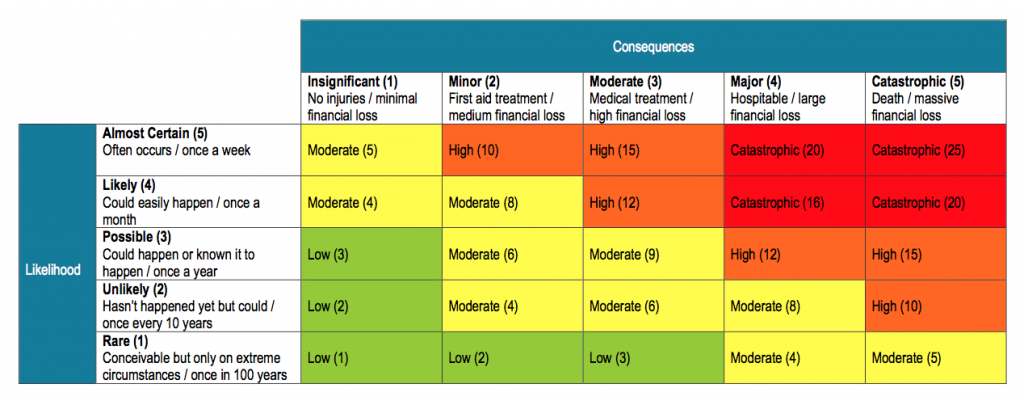
Every state and territory in Australia has its own form of Workcover which means that this is only a broad example of a industry standard risk assessment matrix. Although Workcover deals with risk assessment reports for matters of workers’ compensation, it is not directly involved in the process of writing risk assessments. Nonetheless each state or territory’s Workcover does provide a risk assessment guide for matrices but some are better than others. For instance take a look at this example of risk assessment matrix from Workcover NSW.

It’s very simple and does not serve as a exemplary industry benchmark for a compliance risk assessment matrix but it does serve to convey the underlying meaning of what is a risk assessment matrix. Each risk or hazard is allocated a number. The higher the risk, the higher the number and the same rule is applied to the likelihood of a risk occurring. Then these numbers are multiplied together and an aggregated number for the total risk involved in any workplace is given. For a more thorough risk assessment matrix example check out the below template from SafeWorkPro.
The Technology to Improve Productivity
Occupational health and safety is a time consuming task that every business, construction or otherwise, has to deal with on a daily basis. In construction, the time-cost associated with the mandatory risk assessment process is demanding for both workers on the job and managers back at the office. But safety and productivity are not mutually exclusive and do not need to come at the cost of one another.
There is technology to improve productivity and it isn’t space age nor is it overly complicated. It is in fact, quite simple.
Software risk assessment makes knowing how to improve productivity much easier. Risk assessment tools like SafeWorkPro utilise powerful but easy to use technology to streamline the risk assessment process. It cuts out the paperwork involved and replaces it with an easy to use tool available to download on any smartphone. Automated forms save risk assessment entries, storing them as PDFs to make displaying compliance as easy as sending an email.
The benefits are clear:

- Workers spend less time on risk assessment paperwork and more time on the job
- The backend administration of risk assessment forms is digitalised making filing and storage easier
- Displaying compliance in safety audits or inspections is as easy as sending an email
- Workers and managers can share critical safety information in real time
- The software can be downloaded to any smartphone or tablet device, and works without an internet connection
- Cost effective and easy to use
The goal of any construction technology that seeks to improve productivity is to advance what risk assessment systems already exist. Remaining compliant and in line with current OHS laws is critical for not only preventing workplace injuries but also ensuring construction businesses are not penalised. This is the simple brilliance of risk assessment software, but there is so much more to it than these initial benefits.
For more information on the type of risk assessment software you need, just ask these five questions.
How Can Safety Audit Software Help You?
How do you know if your risk assessment in the workplace complies with OHS legislation Australia? Risk assessment in construction is not an exact science and mistakes can be made. As a manager or business owner, it’s your legal responsibility to ensure your workforce is safe and compliant, or else you risk the regulator’s wrath.
How to Complete a Risk Assessment?
The traditional method involves streams of paperwork that is both a hassle to fill out, file and find if regulators ever submit a compliance request. There are safe work method statements (SWMS), risk assessment matrices not to mention the risk assessment process itself. A compliant risk assessment workflow involves all of these different bureaucratic functions but it doesn’t have to stunt your productivity. In fact with the help of construction risk assessment software, your productivity should improve.
How to Improve Productivity?
We’ve developed a digital alternative to the paper-based method that saves time and money. Called SafeWorkPro, it’s simple risk assessment software designed in consultation with construction workers and managers. One of its many features is as safety audit software – a function that stores risk assessments, SWMS and other related documents as a PDF. Should any regulator request risk assessment documents, you can access them in one computer file and email it instantly. It cuts out administrative overhead and gives you more time for other jobs.
A lot of mistrust gets thrown at risk software because the paper-based method, although seriously flawed, has been around for years. But to improve productivity while remaining compliant, you’ll need to move into the digital world with SafeWorkPro.