
3 Signs Safety Software Might Be The Solution For You

Safety software is a relatively new solution to an old problem. Have you ever thought to yourself, there has got to be a better way to stay complaint with safety regulations? Do you ever get frustrated that you have to fill out so many assessments and statements on paper. Do you find yourself missing things in your assessments because you are worried that it’s not in the right format?
These are just some of the frustrations that come with the process of staying compliant with safety regulations. It can have significant effects on your safety culture if you find the process of safety too difficult. If you have ever ran into any of the above, it might be time to consider finding a solution before it becomes too much of a headache that safety goes out the window and all your effort is spent just to be compliant.
In this article we will cover in depth 3 signs that it might be time to consider utilizing safety software before your safety is ignored for compliance.
You’re worried about compliance incase of an incident

Running a business is no easy task. It’s like juggling 10 things at once. When things are going well, it’s a great feeling. But it only takes one slip up or incident to cause everything to come crumbling down. The stress and anxiety of a WHS incident happening in your business is enough to keep anyone up at night. On top of that, if you know you might get slapped with a fine after the incident you’ll always be stressed or worse, you’ll delay reporting an incident. This can lead to huge fines and even jail time. No one wants that.
Safety compliance in the modern day is no simple task. There are a lot of regulations and legislation that you must adhere to in your day to day business. This can become quite a headache and adds to the stress of making sure you have ticked all the boxes. Or worse, leads you to ignoring your requirements and hoping that an incident doesn’t occur. As we have covered in a previous article, incidents happen to even the best of employers who are proactive with safety, its simply the reality of probability. If there is a chance, eventually it will happen.
Ask yourself this. If there was an incident at your workplace tomorrow and it lead to an inspection, would you be confident you would pass? Have you got a solid and refined risk assessment process in place to identify, assess and control risks in your workplace?
If the answer is not a confident yes then it might be time to look at solutions. Safety software like our platform SafeWorkPro allows you to focus on your process more while making the document compliance side of things a worry of the past. While SafeWorkPro won’t solve all of your safety worries, it will help you be more effective with your time so you can spend less time filling out forms and more time focusing on the actions that lead to a safer workplace. We have talked about how your process is more important than your documents in a previous article. In the eyes of the law, the concern is about what you actually do to keep people safe.
If you want to spend more time on safety and less time on the books, then safety software might be the solution for you.
Safety software makes documentation simple and easy
How long does it take you to complete a risk assessment from start to finish? What about a SWMS? Do you find it difficult to complete documents because of all the back and forth that is required between the site, office and in between your workers? If your documentation process is top notch and you have no issues with filling out lengthy paper documents then this might not apply to you. But for those that get frustrated with how much time away from work they have to take to complete documents, this one might be for you.
When the bottle neck for starting a job is the paperwork you need to complete for safety compliance it can become frustrating. It can sometimes feel like too much time is being wasted on paperwork when you could be working. This can lead to rushing through it which defeats its purpose. It also means that you are more likely to skip the processes that really matter to keep people safe.
If you are on a site that needs a SWMS and something changes that requires you to re-evaluate your SWMS, the process starts again and the tools are down until it is done. With safety software, the process of completing documentation is significantly easier. In principle, it is the same but in practice you’re saving time that would otherwise be spent filling a document and running around to get it signed. SafeWorkPro’s simple form based builder allows you to build custom documents which are super simple for your workers to complete on site when needed.
Save the hassle of the back and forth trying to get your documents read and signed by those on site. Have workers fill and sign documents from anywhere on site and have them submitted to the cloud for you to review from any location. SafeWorkPro even lets you get notifications when certain actions happen like a risk rating on a risk assessment matrix being too high or an incident is submitted. SafeWorkPro can help you save time on compliance and let’s you focus on what you do best.
Safety software helps you find old documents quick

Ask yourself this, can you find your risk assessment or SWMS from a job 2 years ago? If you were audited, could you produce it? This is something that isn’t obvious until it is an issue and by then it’s too late. How much of an impact on your day to day operations would a surprise audit have? Would you need to go digging through the back office folders to find the documents required? What a headache!
Even while you are on site, your documents like a SWMS need to be available for everyone to see. While they are there, they are likely to get damaged or degraded by weather. Sometimes, by the time they get stored for safe keeping they are almost falling apart.
With the safety of cloud document storage, SafeWorkPro can store all of your important documents online forever. With all of your documents in one place and neatly organized it’s super simple to find the documents you need, even if they are from years ago. Our software also makes audits quick and easy with next to no disruption in your operations. Export all of the data from your SafeWorkPro site for review without having to spend hours digging through folders, photocopying and physically delivering documents.
Conclusion
If any part of this article resonates with you, it might be time to consider trying out a better solution to using a manual safety process. Beyond just the convenience, SafeWorkPro can help you focus your time on the actions that truly make people safe, not just the actions that make you compliant. At the end of the day, that is what you will be judged on if you have an audit or investigation. Documentation is required of course, but that is simple the surface level when it comes to safety.
If you want to learn more about how SafeWorkPro could help you in simplifying your WHS, reach out to our friendly expert staff for a free, no obligation live demo.
Guidelines For Risk Assessment Software
Safety compliance software, health and safety software or risk assessment software? What’s the difference? Well these are but just a few names for what is essentially the same thing: software that makes the risk assessment process both more efficient and more compliant with OHS laws.
But not every aspect of risk assessment software development is up to the risk assessment standards enshrined in OHS legislation Australia. Therefore choosing the most appropriate software is a decision that will have long-term effects on your construction business. Making the right decision is vital so here are a few guidelines for risk assessment software that can help you make an informed choice.
Compliance is key
OHS laws and regulations are strictly enforced across all Australian jurisdictions so the software you choose must conform to the relevant standards. Remaining compliant with regulatory obligations means that your business will not only avoid costly penalties, but also that your workforce will maintain a healthy safety culture
For more information on the codes of practices outlined by Safe work Australia, click here.
Software must benefit your business practices
Risk management in software engineering is a complex process and because of this, some platforms are not flexible enough to apply for a multitude of different business types. The health and safety management software you choose should not only fit into your established business practices, but it should also improve them. Safe operating procedures do not need to come at the cost of productivity or efficiency.
What works on paper may not work in practice
You can have the most advanced risk assessment software available but if it is too complicated to be used efficiency than it may end up costing your business more than it saves. Usability is everything and ensuring that you have risk management software that is both comprehensive and easy to use will translate those predicted benefits into tangible results.
These are but simple guidelines to help you make the best choice for your specific circumstance. Nonetheless it is vital that any choice made in regard to risk assessment software is backed by facts, data and reliable business information. For more information on the software offered by SafeWorkPro, head to our Blog.
Why Are Risk Assessments Carried Out On Paper?

Back in the good old days the various stages of risk assessment involved turning up to work and not getting hurt. It was a simpler risk assessment system but suffice to say it didn’t do a lot for safe operating procedures.
We joke about it now but this history of poor workplace health and safety practices highlights the importance of a risk assessment. Paper-based risk assessments have helped keep workers save for decades but now in the digital age, they are quickly becoming redundant. New software alternatives are quicker to complete and easier to administer, which begs the question: why are risk assessments carried out on paper?
The simple answer is because it used to be the easiest way of carrying out a risk assessment. That isn’t to say writing risk assessments on paper is still the easiest way to do things. The table-based risk assessment layout works well for paper but now with risk assessment software development extending well into the construction industry, it’s become clear that the future of risk assessment is found in technology.
You can find out more about construction risk assessment software here. For more useful tips and information, check out the SafeWorkPro Blog.
What is a Risk Assessment Matrix?
What if I told you that construction risk assessments were so unnecessarily complicated that they actually constrain your productivity? If you’ve ever had to deal with an OHS risk assessment matrix than you’d know what I’m talking about.
Even the best risk assessment matrix can be long and overcomplicated. This means that workers have to stay off the job for longer just to finish the required risk assessment forms. But what is a risk assessment matrix?
Risk Assessment Matrix Template
Risk assessment matrices are a common tool for risk evaluation and are used through a variety of industries and professions. The aim of a risk assessment matrix is to determine the likelihood and consequence of various health and safety hazards and risks. Usually presented in a table or graph format, risk assessment matrices usually offer three standards:
1-2: Low likelihood, low consequence: this area usually indicates that the health risks at work are either effectively controlled or are not prevalent enough to warrant concern.
3: Medium likelihood, medium consequence: these risks are usually judged to be controllable within reason and represent the bare minimum of acceptable risk in the workplace.
4-5: High likelihood, high consequence: risks identified in this area require stronger control measures to fall within reasonably practicable health and safety standards.
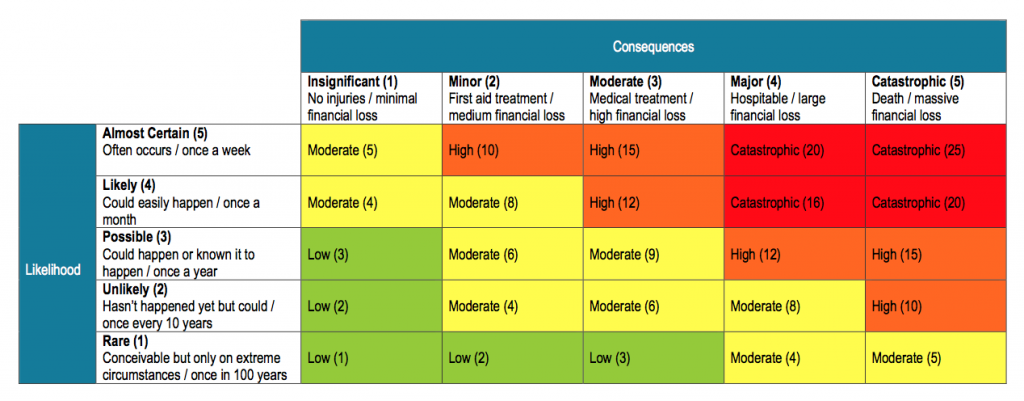
Along each axis of the graph, the various levels of consequence and likelihood are numbered. To retrieve an accurate level of total risk, these numbers are multiplied together according to where the specific risk falls on the graph or table. Although most businesses will have different guides, this general risk assessment template provides a basic understanding of a standard risk assessment matrix example.